
Appearance
Scheduler
The Scheduler triggers automatic playback actions at a set date and time, once or on a recurring schedule — useful for permanent installations, digital signage, and automated broadcast playout.
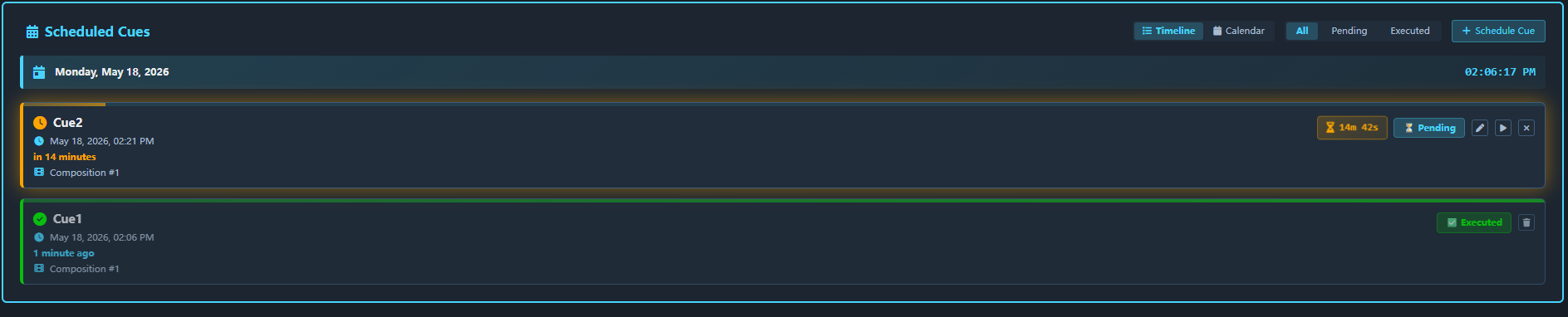
The Scheduler view features a visual timeline with real-time updates: progress bars show elapsed time on running schedules, countdown timers show when the next event fires, and colour-coded status indicators (blue = pending, orange = imminent ≤ 30 min, green = executed, red = overdue) give immediate situational awareness. A calendar view is also available for a monthly overview of all scheduled events.
Accessing the Scheduler
Open the CONTROL tab in the header of the main window (or the standalone page /control) and switch to the Scheduler sub-tab. In Easy Mode the sub-tab is called Schedule. See Operator Control View.
Click Add item to schedule an action, or click a day in the calendar view to schedule one on that day.
Scheduled Items
Each scheduled item has:
| Property | Description |
|---|---|
| Action Type | What to do (see below) |
| Scheduled Date & Time | When it fires first (date and HH:MM) |
| Repeat | Off = fires once. On = repeats with the Repeat interval below |
| Repeat interval | Daily, Specific Weekdays (tick the days under On days), Weekly, Monthly, or Every N minutes (Ride Cycle) |
| Cycle interval / Operating hours | Only for Every N minutes: every 5, 10, 15, 20, 30, 45 or 60 minutes, and only between the two times of day (default 09:00–17:00) |
An item has no enable switch: to stop it, remove or cancel it. Run now (the ▶ icon on the item, and the button in its Inspector) makes the engine run an item immediately; a one-time item then counts as done, a repeating one keeps its schedule.
How repeats are counted:
- Monthly repeats on the same day of the month. In a month that is too short for that day (the 31st in April, the 30th in February) it runs on the month's last day, and returns to the original day the month after.
- Specific Weekdays: the first date you pick always runs, even if its weekday is not ticked; after that only the ticked days.
- Every N minutes with operating hours runs from the opening time in steps of N minutes, up to and including the closing time. On the first day the steps start from the time you picked. Operating hours that end before they start (e.g. 22:00–02:00) run overnight.
Actions
| Action | Description |
|---|---|
Cue | Fire a specific cue of a composition in the current project (on a playlist, a media item) |
Projector | Send a PJLink command (power on/off, mute video, …) to one configured projector |
All Projectors | Send a PJLink command to every configured projector at once |
Custom Control | Trigger or set the value of any item you've pinned to the Custom Controls panel — this is how to schedule things like starting/stopping/pausing a composition, or any other project value (e.g. a blackout toggle), since there is no dedicated "play project" or "fade to black" action |
System | Shut down system or Restart system — shuts down or restarts the machine the Exaplay engine runs on |
There is no standalone "load a .vpp file" action — the Scheduler operates within the currently loaded project. To switch projects on a timer, use the OS Task Scheduler to launch exaplay3.exe -f <project>.vpp instead.
Example: Digital Signage Loop
- Pin a "Start" and "Stop" control for the
Morning_Loopcomposition (and, if you want a blackout, a control for that too) to the Custom Controls panel, then schedule (each with Repeat → Specific Weekdays): 08:00Mon–Fri →Custom Control: Start Morning_Loop18:00Mon–Fri →Custom Control: Blackout(orCue: Fade to Blackif you've built one into the composition)09:00Sat–Sun →Custom Control: Start Weekend_Loop22:00Sat–Sun →Custom Control: Stop Weekend_Loop
Who runs the schedule
The schedule is stored in the project, and the engine runs it — no browser needs to be open. The engine reads the schedule when a project loads and whenever it is edited, checks it every 10 s, and works out each repeating item's next time itself. After an engine restart (a crash recovered by Auto-Heal, a scheduled reboot, a System action) the schedule carries on by itself. The Control view is where you edit the schedule and see what the engine did.
When the engine was not running at the scheduled time
- An item that is up to 15 minutes late (for example, the engine was restarting) still runs, once, as soon as the engine is back.
- An item that is more than 15 minutes late is not run. It is marked Missed, and the engine log gets one line about it. A repeating item then moves on to its next time from now. Missed occurrences are never replayed one after another, so after a weekend switched off a daily item runs once at its next time, not three times.
This matters most for System restart/shutdown and PJLink power actions: a projector power-on from the morning is not sent in the middle of the afternoon. A scheduled Restart does not run again when the machine comes back up.
Multiclient
In a multiclient rig only the master (or a standalone machine) runs the schedule. Every machine carries the same project, so otherwise every machine would restart itself, send the projector command, or fire the cue. Clients follow the master's playback through Playback Sync. The one exception is a Custom Control that sets a value: every machine applies it, as with Inputs value mappings. On a client, the Scheduler shows Runs on the master, and Run now is refused there. Run it on the master.
Visual Timeline Features
Live Clock
The Scheduler view shows a live current date/time display, updated every second.
Countdown Timers
For imminent schedules (within 30 minutes), a countdown timer shows exactly how long until the event fires — e.g. 15m 23s.
Status Colours
| Colour | Meaning |
|---|---|
| 🔵 Blue | Pending — scheduled for the future |
| 🟠 Orange | Imminent — fires within 30 minutes (pulses to draw attention) |
| 🟢 Green | Executed — already fired successfully |
| 🔴 Red | Overdue — past its time and not run yet; the engine runs it within the 15-minute grace or marks it Missed |
An item whose action could not be carried out (for example a projector that did not answer) is marked Failed. An item that was more than 15 minutes late is marked Missed. An item the engine was running when it stopped is marked Unknown and is not run again. The exception is a scheduled restart or shutdown, which counts as Executed.
Quick Filters
Use the All / Pending / Executed filter buttons to show only the events you are interested in.
Calendar View
Switch between Timeline and Calendar using the toggle buttons in the Scheduler header. The calendar view displays a monthly grid with colour-coded cue chips on each day. Navigate between months with the ◀ / ▶ arrows, or jump back to the current month with the Today button. Your chosen view mode is remembered across sessions.
Timezone
Times are local wall-clock times of the engine machine (in a multiclient rig, the master). A daily 03:00 item stays at 03:00 across a daylight-saving change. The date and time you enter in a browser are read as that machine's local time, so use a browser in the same time zone as the engine. Keep the engine machine's clock correct (NTP recommended for time-critical installations).